


Joep Wennemars Olympic Re-Skate: When the Ice Said “Nope”


Alright, folks, strap in. On Wednesday, February 11, 2026, Dutch speed skater Joep Wennemars got a masterclass in something the ice has been trying to teach humanity for millennia: life doesn’t give a damn about your plans.
Picture this: he’s flying down the 1000 m like a human missile, carving perfect lines, probably imagining the headlines. Then, in a moment that could only happen at the Olympics, Chinese skater Lian Ziwen drifted wide in a key crossover, clipping Joep’s lane. Collision! Milliseconds vanished! Momentum? Gone! Ego? Slightly bruised. Public humiliation? Imminent. And somehow, Lian managed to turn a simple crossover into a plot twist worthy of a soap opera — if Olympic speed skating had a “chaos cameo” award, he’d be a shoo-in.
That little interference cost him roughly nine strokes, the kind of micro-disaster that almost certainly turned a potential bronze medal into a footnote in Olympic history.
Here’s the kicker: earlier today, Wednesday, this became the first time in Olympic long-track speed skating history that a competitor has been awarded a re-skate due to interference — and this time, he had to skate alone, with no direct competitor to push him, no pack to chase, just him and the clock. According to the International Skating Union: “A competitor who is interfered with through no fault of his own shall be allowed a fresh start, and the best time of the two races shall count.” Translation: the ice may be chaotic, but fairness still exists… kind of. And yes, Lian Ziwen got the official slap on the wrist — disqualified for interference — while Wennemars was awarded a re-skate, a do-over that gives him a second chance to show the world he’s the human missile he thinks he is.
Like father, like son: same collision, same chaos, just a slightly different ending.
Funny enough, some things run in the family. Joep’s dad, Erben Wennemars, collided in the same Olympic 1000 m race back in 1998 — shoulder dislocated, race ruined — no re-skate, no second chance, just ice and disappointment. Fast forward to 2026, and here’s Joep: like father, like son, flying down the track, clipped by another skater, nine strokes lost, Olympic dreams teetering — but this time, a re-skate. Same chaos, same heart-stopping drama, just a slightly different ending. History repeating itself, only with a tiny bit of mercy. And speaking of Erben, he just said in an interview that he wants to go home as of now — apparently watching his son relive his nightmare is a bit too much to handle.
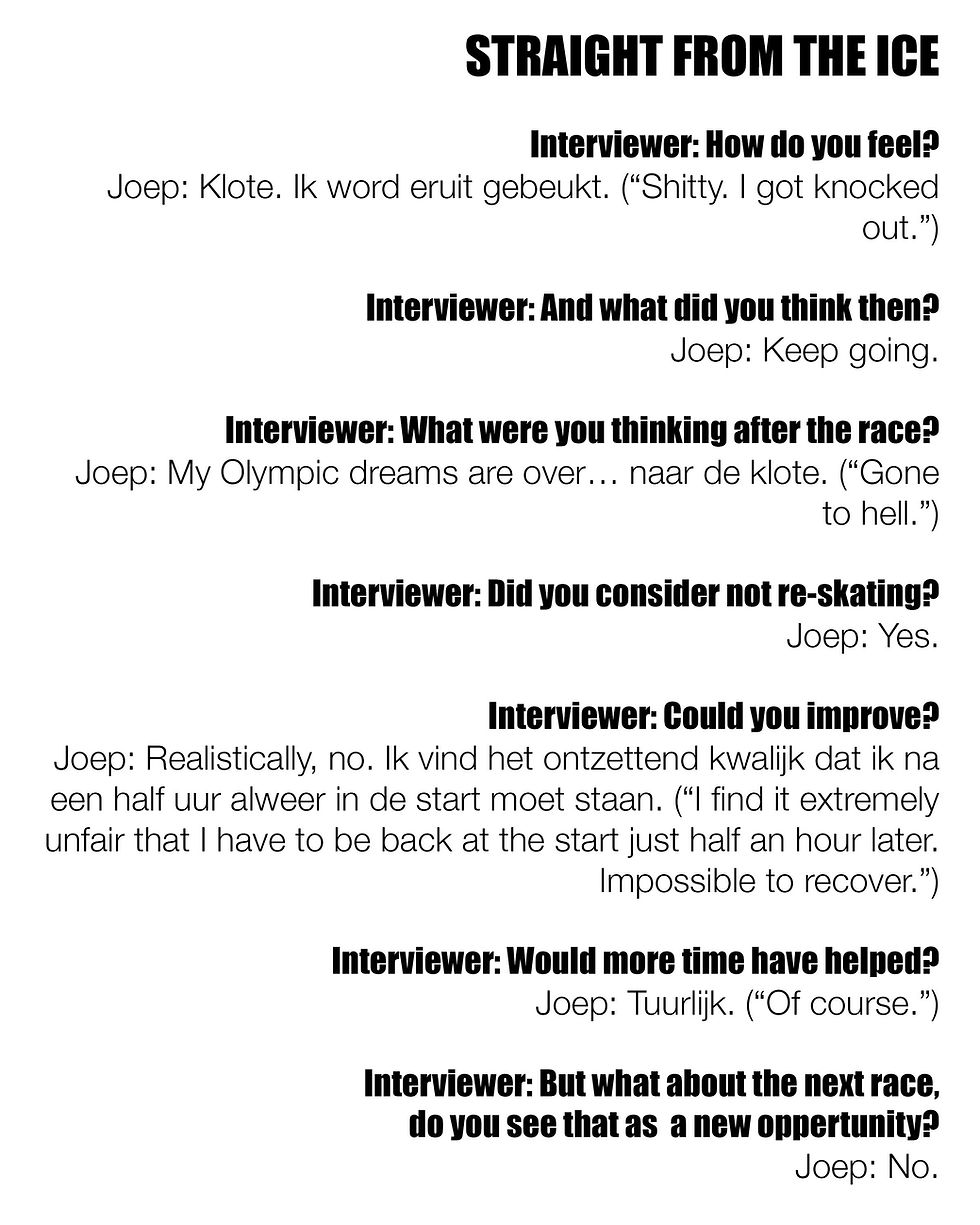
Then came the moment we all live for: the interview. Joep’s reactions were perfectly human, perfectly real. “Klote. Ik word eruit gebeukt” (“Shitty. I got knocked out”). “My Olympic dreams are over… naar de klote” (“gone to hell”). Half an hour to recover? “Elke minuut telt” (“Every minute counts”). Could he improve? Realistically, no. Could he think about the next race? Not even a little.
There he was, alone on the ice, facing the clock, a disrupted dream, and the absurdity of Olympic timing staring him down.
Watching him flare, exhale, and psych himself up for the redo is pure theater. Forget medals for a second. Wennemars also gave a masterclass in composure under pressure, resilience in the face of chaos, and elite-level speed skating craft. This is raw human drama: lineage meets pressure, ambition meets chaos, and the ice? The ice watches, smirking.
Will he medal? Maybe. Will it make for a better story than the podium? Absolutely. In that collision, in that tiny moment where Lian Ziwen’s misstep and Olympic law collided, Wennemars reminded everyone why we watch the Games: it’s not perfection we crave, it’s unpredictable, unfiltered, electrifying human drama.
Imagine being nervous, angry, and still upset at the same time — that’s basically how I watched the whole thing, except with more coffee and less speed-skating grace.


Comments