


SEXISM, PRICED IN PINK: THE PINK TAX AT THE DRUGSTORE

Updated: Aug 11
EDITOR'S NOTE
Every magazine has an aisle it can't ignore. Ours glitters with pink and gold-black, priced by a logic no one wrote down but everyone pays. In this issue, a father and his fifteen-year-old daughter walk that aisle together, but this time, she's the one reading the labels.
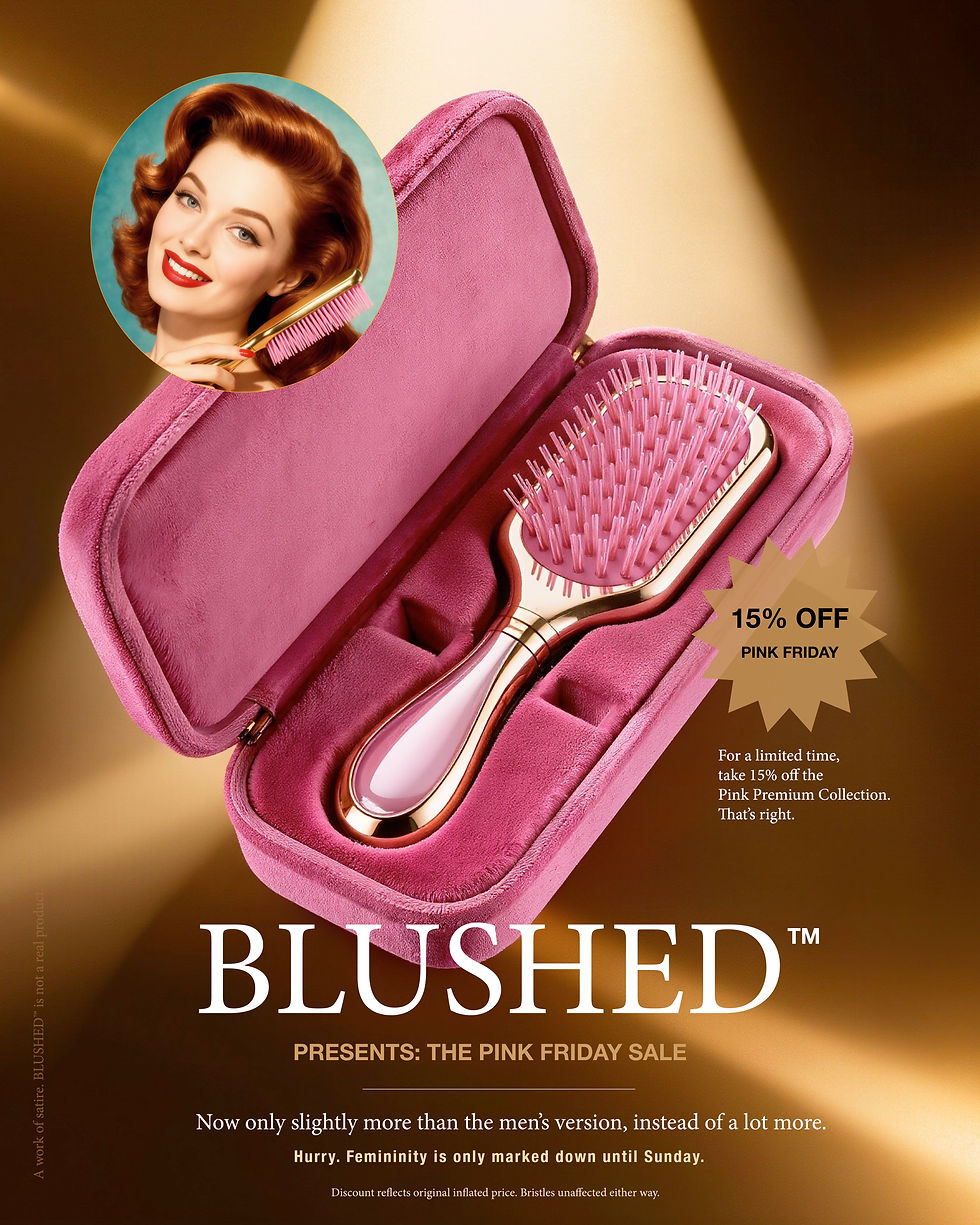
The thesis fits on a hairbrush: color changes meaning once a price tag is attached. What Lynn notices in a dollar store, four dollars versus nine for the same thing, echoes the argument this magazine has made since issue one. The visual language sold as personal preference is often just a business model in lip gloss. Pink didn't pick women; someone picked pink, then charged women for choosing it back.
What makes this piece work isn't outrage. It's a teenager doing the math out loud, and a father wise enough to listen, honest enough to admit where his own eye still snags (that "special" section, the discomfort he can't fully name). No one claims to have it all figured out. That's the point. Sexism rarely makes headlines. Sometimes, it arrives priced in pink, and a girl is the first to notice.
by Sixten "Dad" Rebel, with Lynn "Princess" Rebel
Lynn, my fifteen-year-old daughter, has her own attitude, her own dress code, her own ideas—a young woman in the making.
She needed a weekend off (yes, divorced, thank you for noticing), and at her age, I got that. So she stayed with me.
That being said, we went shopping. I asked her what she needed and which stores she wanted to hit. First stop: the kind of place you'd call a dollar store, looking for a hairbrush. They were all out, at least the ones that didn't look like they'd come out of a bubble gum machine. The colors hurt my eyes, and the shapes were... well, interesting. Anyway, we went to another store, and there she found one. That thing was expensive, at least for a hairbrush. But who knows, right? I'm her dad, and a guy who doesn't exactly go looking for hairbrushes. She found one she liked, and we moved on to the next store.
Picture this: The dad, Mister Rebel if you like, is wearing short army pants, worn-out shoes, and a metal shirt from some obscure Norwegian band. She’s in a white tank top, baggy jeans, and similarly worn-out shoes. Together, we strolled through the women’s lipstick, perfume, eyeliner, nail clippers, and hair products section.
To my surprise, those "special" nail clippers cost almost fifty god-damn bucks. But that wasn't the biggest thing. What I actually wondered about, positively, were the answers she gave me to my questions.
The question was: why are the women's products displayed in glittery pink and red?
This is what she said:
"Dad, that's because it's sexism. It's just plain and simple sexism. It's sexists to think all women like red and pink and lilac colors."
Nearby, there was a section for darker colors, anchored by a photograph of a beautiful Black woman. The display gleamed in black and gold, showing off deeper shades of lipstick and eyeliner. I’ll admit, it struck me as odd, maybe not overtly racist, but something about the separation felt off. Unless someone convinces me otherwise, I’ll keep wondering about it.
Lynn continued:
"Those colors are 'special' for women. Like, the same brush in the men's section is exactly the same, but two or three times cheaper.
Men don't care as much about how it looks, just whether it works. Women care more about how it looks, not just whether the brush works for their hair. And women buy more products, so they charge more to make more money.
Your brush costs like four bucks, mine costs like nine. Same thing, different price.
So I say it's sexist to charge women more than men, and it's ridiculous they use these stereotypical colors like all women like them, which isn't true."
She kept going:
"Also the perfume. I like this one, and when I like something, I buy it. I'm not wearing men's perfume."
Naturally, I couldn't resist checking out the guys' smelly cologne section myself (I don't actually use the stuff, I'm a body spray and deodorant guy, that's it). And she was right about that, too: the men's section was cheaper, though not by as much as I expected.
It was, without question, an interesting hour of shopping. And I was surprised that this was on her mind. Surprised in a good way, of course. I forgot to ask whether this applies to other women's products, like clothes, jewelry, and shoes. I'm not sure. Probably it does. I didn't fact-check it.
Lynn will always be my princess, but this shopping trip showed me she's already becoming her own person, someone who notices the price of pink, asks the right questions, and refuses to accept the easy answer. Maybe I didn't have all the answers for her, but that's the point: we're both still learning. The aisle we walked together wasn’t just about hair brushes or nail clippers, it was about seeing the world a little clearer, and realizing how much more there is to question.
With love,
Sixten


Comments